|
 Jews
always loved their motherland. But for many generations Eretz Israel was only
a dream. The first settlers who came there in the beginning of the XX century
saw that their dream was turned to a desert and malarial swamps. The Jews decided
to revive the land flowing with milk and honey. Jews
always loved their motherland. But for many generations Eretz Israel was only
a dream. The first settlers who came there in the beginning of the XX century
saw that their dream was turned to a desert and malarial swamps. The Jews decided
to revive the land flowing with milk and honey.
After the state of Israel was funded in 1948 fighting desertification
became a national policy. Fauna was recreated simultaneously with flora. Eretz
Israel was reviving!
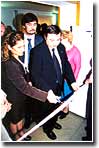
Today citizens of Almaty have an opportunity to see it with their
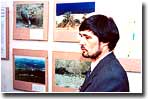
own eyes. Oleg Belyalov's photo exhibition "Nature of the Promised Land"
began in April 10. It attracted not only average men, but official persons as
well. Representatives of the Embassy of Poland, Consulate of Israel in Kazakhstan,
Euro-Asian Jewish Congress and the Assembly of Kazakhstani Nations
visited it on the first day.
 "When
you get to Israel of the XXI century it is hard to believe that every grass,
every flower, and every tree was planted by the hands of men", - Oleg
Belyalov said. "Eucalyptus groves and coniferous forests, orange trees
and branchy platans beautify the country. Fallow-deers, turtles, porcupines,
caracals, and gazelles became typical for the wild nature again. The land of
our forefathers is gaining its primeval magnificence!" "When
you get to Israel of the XXI century it is hard to believe that every grass,
every flower, and every tree was planted by the hands of men", - Oleg
Belyalov said. "Eucalyptus groves and coniferous forests, orange trees
and branchy platans beautify the country. Fallow-deers, turtles, porcupines,
caracals, and gazelles became typical for the wild nature again. The land of
our forefathers is gaining its primeval magnificence!"
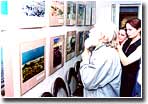
The photo exhibition "Nature of the Promised Land" became
an important event in cultural life of the city. The major republican mass media
told people about the new present from the Jewish community of Kazakhstan.
 "Most
of the tourists in Israel simply don't realize that they see a 60-year-old country".
The chief editor of "Davar" newspaper Ludmila Varshavskaya commented
on the interest paid to the exhibition. "Ancient settlements, historical
monuments, sacred places, and famous museums don't let people feel youth of
the country. But in spite of its old history, Israel is a debutant in comparison
with European countries. That is why the mass media, Embassies, and citizens
look at Belyalov's photos with sincere interest and see the real face of the
people that have lived near for many centuries." "Most
of the tourists in Israel simply don't realize that they see a 60-year-old country".
The chief editor of "Davar" newspaper Ludmila Varshavskaya commented
on the interest paid to the exhibition. "Ancient settlements, historical
monuments, sacred places, and famous museums don't let people feel youth of
the country. But in spite of its old history, Israel is a debutant in comparison
with European countries. That is why the mass media, Embassies, and citizens
look at Belyalov's photos with sincere interest and see the real face of the
people that have lived near for many centuries."
Галина Гольдберг
|








