|
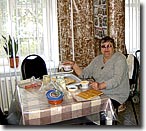 I was born in April, 1938 on Ukraine in Herson, near Odessa. The father worked as the engineer - technologist on Herson canning factory named after V.I. Stalin. The factory produced canned food for front. In 1942 Germans began to rise to Herson, and it was decided to evacuate a factory in rear. The mobile groups were created or as now would tell "field mini factories ", which were sent on Kuban and Caucasus for processing of receding cattle and stayed agricultural raw material. One of such groups was headed by my father. I was born in April, 1938 on Ukraine in Herson, near Odessa. The father worked as the engineer - technologist on Herson canning factory named after V.I. Stalin. The factory produced canned food for front. In 1942 Germans began to rise to Herson, and it was decided to evacuate a factory in rear. The mobile groups were created or as now would tell "field mini factories ", which were sent on Kuban and Caucasus for processing of receding cattle and stayed agricultural raw material. One of such groups was headed by my father.
What this group represented? These were two "Studebaker", something like our Kamaz: on one there was equipment on another the workers. The workers these are soldiers, so that time named the wives, those who were at war at the front and children - without fathers. Moved from one canning factory to another. That time there were many of them in the south.
Came on a factory processed receding cattle and everything, that it was possible to process for canned food, which were sent on front. The women and teenagers worked practically round the clock. From the men were only my father and lame mechanics, which on front was not taken. As soon as Germans rose to a factory the people and the equipment were immersed on "Studebaker" and sent forward, and mechanics blew up it, that it has not got to an enemy.
So we moved from a factory to a factory inland. On one of such transitions we were bombed. It was under Tuapse. The mountains began, the machines should be replaced by carts. Evacuated and the refugees, moved on mountain serpentine road, above which appeared "Kukuruznik" and began to fire at our column. It would seem what the five years' child can remember? But, probably, truth is spoken, that children's eyes are like camera. I remember the turned cart, pool of blood beating in it horse, children's weeping, shouts and low-flying, rowling, shooting plane. This picture still stands at my eyes. What miracle we remained alive - it is known only to the Most High.
Further we advanced on foot from aul to aul on mountain tracks of Southern Ossetia. Thus, we reached Gori city. On a way to us rendered hospitality ossetin people - gave night's lodging, fed up. Once a week the women baked corn lepeshka in tandyr and presented us, children with one lepeshka for two.
By the end of war, in process of clearing the seized territories our group began to move back. Arrived on the blown up factories, restored, adjusted technological process and let out production. In the country reigned famine and ruin.
So, gradually we have reached up to Slavic stanitsa nowadays city Slavyansk. That time it was the main railway centre, and consequently it was ruthless bombed. I remember mass of broken cars, tanks and site of fire from the burnt houses around.
Here we met Victory Day. It was morning of May 9 about 9 o'clock. On stanitsa the desired word "Victory" departed. Everyone reacted in own way: one cried, others pleased, but there were not indifferent. From all houses began to take out tables and to lay them, with what the G-d sent. Us, children allowed to one table with the adults and treated with tastiest things. To me has got whole boiled egg, its taste I still remember.
My father after a Victory was awarded with a medal " For heroic work in Great Patriotic War 1941-1945". Here, in Slavyansk, I went to school. My first school was a barrack with self-made tables, benches and stove. In the winter by first in school came stoker, then teacher. The teacher met children and warmed them at stove. Children were badly dressed, carried any rags, especially there was no footwear. When children would come in themselves, would get warm the lesson began. Sometimes lesson passed directly at stove. It was heated by brushwood, which after lessons was collected by children together with the teacher.
On Kuban, in this usually rich, blossoming edge reigned afterwar famine. Among the schoolchildren there were many children with plump stomaches. Such guys were fed up. From a factory on the large break brought two barells one with pearl soup, another with compote from dried fruits. Many it rescued from hungry death.
There was no soap, burned up beet tops from sunflowers, got ashes, with it laundered on river and washed. The people were sick and died. The most widespread illness was lobar pneumonia - illness of poverty.
By 1949 we came back in Herson. Here I finished ten-year secondary school and in 1964 and Kiev institute of technology of a food-processing industry.
In the country the new fight began - for bread. The virgin soil was accustomed. As the young expert I got in Kazakhstan. I got assignment in city Tselinograd on start of bread-baking plant. Having arrived on a factory, to me told, that it is enough technologists here, and there were not economists: "Take a planning section ". I tried to object, I said what is the economist of me? I was answered: "We have not others. Work". So I became the chief of planning-industrial department of "Tselinhleb". From computer facilities were only counting frame and broken calculating machine. The staff was not there, I should create it. I had no any experience of work any to ask there is nobody. Half-year I cried and worked, and then became some how easier.
In 1967 I got married. My husband also young expert the engineer hydraulic engineer built Stepnogorsk reservoir on the river Selete. I arrived on Hydrounit, it was the Komsomol-youth construction in steppe in 90 kms from Stepnogorsk. I had not work on speciality, but to go for a walk to me it was not necessary. It was necessary to teach youth - school was constructed, and there were not teachers. In Tselinograd the 2-rate of pedagogical institute worked only. In work at school involved all educated people. I also was offered work, and I became the teacher. I taught chemistry, physics, mathematics and even Russian.
In 1993 I was retired on pension. Behind shoulders I had 36 years of the engineering-teaching experience. This 2008 I was 70 years old.
In Kokshetau Hesed "Nathan" I found the warm house, cosiness for soul. I am volunteer, I manage culinary club. Here we revive the Jewish cuisine, Jewish way of life, tradition. Our club cooks celebratory Jewish dishes. In Hesed I have no time to bore.
|








