|
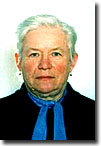 Nina Frantsevna Lisovskaya-Ovsyannikova worked as an obstetrician in Smirnovka village of Kostanay Oblast from 1956 until retirement in 1992. During the war kind people saved the life of the little Jewish girl. After the war she thanked the world by helping hundreds of children to be born. Everybody in Smirnovka knows her. Until now, people come to see her to get an advice. She organized a health group, participates in different amateur talents groups. She is a mother of two wonderful sons and a grandmother of five grandchildren.
Before the war Lisovskiys family lived in the Ukraine, in Kiev Region in Kodra village. The father, Frants Martynovich Lisovskiy, went to the front. The mother, Sonya Moiseyevna Lisovskaya-Askelrod, stayed at home alone with children - Josef was 13 years old, Maria - 6, Nina - 3.5, and Mikhail - 2. Before the German occupation, the family lived in a big house full of flowers, some of which were as high as the ceiling. The family had a pet - a squirrel tamed by the children. Children played with her and fed her with nuts.
Kodra village was occupied by German fascists from July 20, 1941, to November 10, 1943. At the beginning, the villagers were hiding the mother with children in cellars and pits - nobody delivered the Jewish family over to the fascists. Elder children secretly went to the forest to pick up mushrooms and nuts to feed the family somehow. Once when Josef, Maria, and Nina went to the forest, the Germans conducted a mopping out operation and found Sonya Moiseyevna with little Misha. The Germans gathered all people in the village. They formed a column of all Jews and people who were hiding them and drove them as a herd to an unknown place. The archive contains recollections of eyewitnesses who saw Sonya Moiseyevna running in this column holding her child. The Germans started beating her and the child with butts until she dropped. The child fell out of her hands and German soldiers started beating him with their boots. The child was leaning to his mother, while soldiers continued beating him until he became silent. To have fun, the solders started playing football by using the child’s body as a ball. One of the German soldiers could not look at it anymore; he came up, took the child’s body and threw it away from the road. Sonya was put on her legs and the column continued its way to Kiev where everybody in the column was shot dead in Babiy Yar.
When the children came back from the forest, people told them what had happened. During the day it was impossible to go outside because of the German soldiers. Only at night, the eldest Josef went to look for the beaten to death brother. He found his brother in a ditch and took him to the forest because Germans were afraid to go there at night. Josef was holding his brother’s lifeless body and did not know that he was still alive. In the forest, Josef put the child on the ground and heard a weak moan. Little boy’s legs and arms were broken, and, as it was discovered later, his spine was broken as well. The children were afraid to go back to the village and went further to the forest. It is hard to say now for how long the children were going in the forest carrying their brother on fir branches. Then they met a forester, Martyn. He fed the children and hid them in his house. Martyn examined the youngest boy who was still unconscious and told Josef that if they did not find a doctor his brother would die. It was not possible to go back, because the village had been burnt by the Germans. There were partisan detached forces in the forests and Martyn helped the children join the partisans.
 Thus the children joined the partisans, the Kovpak brigade. There were many children there. Women and old people did their best to help partisans. When the brigade was leaving the camp, children, old, and injured people were hidden in a big two-meter deep hole covered with fir branches inside. From outside the hole was covered with logs, one meter-high layer of soil and covered with trees on the very top. People stayed for several days in such pits. Children were very quiet, nobody cried, even children as Mikhail who were badly injured were keeping silence. They were very thirsty and hungry. It was especially difficult in winter - people could not see the sunlight for months. Often they heard dogs barking, explosions, but the Germans did not find them.
Thanks to Kodra dwellers, the elder brother Josef, Forester Martyn, and Kovpak partisans, the children survived in this terrible war. The father, Frantz Martynovich Lissovskiy, was killed in February 1944.
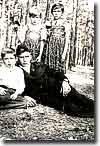
From 1944 to 1946, a 16-year old Josef was taking care of his sisters and organized medical treatment of his brother Misha. Misha was being moved from hospital to another, he was in plaster cast for a year. In spring of 1946 Josef was called up for military service. In the picture children are all together on the day of his going to the army. The youngest Misha, who could not sit or stand up, was leaned to his elder brother. The children were sent to children’s care center, then later to Lyubarskiy children’s home. Misha was sent to hospital (he was disabled for the rest of his life).
Zoya Firenshtein
|








