|
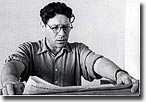 My
grandfather Lev Vladimirovitch Fridman was born on August 25, 1913 in
Odessa. He studied at the University of Economy and Finance in Kharkov.
When he was 20 he married a sixteen-year-old Klara Godfrid. Her friends
tried to dissuade her from marrying "that old fellow"; his relatives
thought that it was too early. But Lev and Klara made a wonderful couple. My
grandfather Lev Vladimirovitch Fridman was born on August 25, 1913 in
Odessa. He studied at the University of Economy and Finance in Kharkov.
When he was 20 he married a sixteen-year-old Klara Godfrid. Her friends
tried to dissuade her from marrying "that old fellow"; his relatives
thought that it was too early. But Lev and Klara made a wonderful couple.
The family began to live independably from the very beginning.
In 1937 a daughter Lola was born to them, and in 1940 - Svetlana, my mother.
Grandfather graduated the same year and began to work in Monchegorsks
town. He took the family with him, but then WWII began and the plant was
evacuated to Kazakhstan.
It was a different life, hard and lean. But the family were
together again. Klara's parents also moved there.
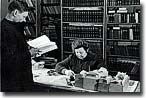
In 1948 the whole family moved to Rudnik village, the center
of copper industry. Most of those who worked in mines were prisoners in
Karlag concentration camp. The staff of grandfather's department was brought
to work under escort. In fact, he was the only free man in the planning
and economic department.
 During the war the third daughter Polina was born to Lev's
family, but she lived only for two years. In 1947 a long-awaited son Volodya
appeared. They lived in huts, several families together. The girls stood
in lines for bread all nights through. Klara's father died, and mother
moved back to Ukraine, where her relatives lived.
During the war the third daughter Polina was born to Lev's
family, but she lived only for two years. In 1947 a long-awaited son Volodya
appeared. They lived in huts, several families together. The girls stood
in lines for bread all nights through. Klara's father died, and mother
moved back to Ukraine, where her relatives lived.
In 1953 the family moved to Zheskazgan. Their life became
easier. They decided not to go back to Ukraine.
Lev Vladimirovitch was a very joyous and kind man. He was
constantly singing or whistling some melodies. The most prominent Zheskazgan
people gathered in his home.
Grandfather loved us, his grandchildren. Especially Boris,
he was a boy. Boris was very thin, and he always needed to be persuaded
to eat something. Grandfather used to cut a sandwich into small pieces,
and "the train went into the mouth". Once the children refused
to eat, and he said: "No lunch. We're going to the water-melon plantation".
Children's eyes sparkled. Grandfather took the food and we went to the
steppe. Our appetite was excited on the open air, and we ate up everything.
Meanwhile grandfather took out three water-melons, put them near the car
and said: "Now gather them - that's what we've come for".
Grandfather had magical hands. He liked to do everything
himself: bound albums, made fishing net - he was a passionate fisherman.
In 1990 grandfather fell ill. He never complained, but grandmother
said: "Lev doesn't whistle - he's ill, then". On October 5,
1990 he passed away. Two years later grandmother followed him.
Valentina Polikarpova
|








